Why a Water Flosser Might Hurt and What to Check

About this guide: Published by Flossy, the retailer of Flossy Oral Jet. This guide includes our own products and provides general oral-care information. For advice about your teeth, gums or dental appliances, consult your dentist.
A water flosser should not cause sharp or lasting pain. If it hurts, lower the pressure and check your technique. Do not assume bleeding is a normal adjustment; a dentist can assess pain, bleeding or sensitivity, especially if it persists or worsens.
TL;DR:
- Proper technique, including starting at low pressure and aiming the tip at a 45-degree angle, is essential to avoid pain and sensitivity.
- Gums that are inflamed, receding, or recently treated are more susceptible to discomfort and require gentle, controlled irrigation.
- Persistent sharp or localized pain signals underlying dental issues such as cavities or gum disease, warranting professional evaluation.
- Devices with adjustable, gentle pressure modes, like the Flossy Oral Jet, help build comfort gradually for sensitive gums or braces.
- Research shows that when used correctly, water flossers do not cause tissue damage and significantly improve gum health compared to brushing alone.
Table of Contents
- Why your water flosser might be causing pain or sensitivity
- How to use a water flosser without hurting your teeth or gums
- When pain or bleeding is normal, and when it’s a red flag
- What the evidence and dental professionals say about safety and sensitivity
- Why gum irrigation felt like a shock the first time I tried it
- Which Flossy device suits gums that need a gentler start
- Sources
- FAQ
Why your water flosser might be causing pain or sensitivity
Discomfort can have several causes, including technique or an underlying dental problem.
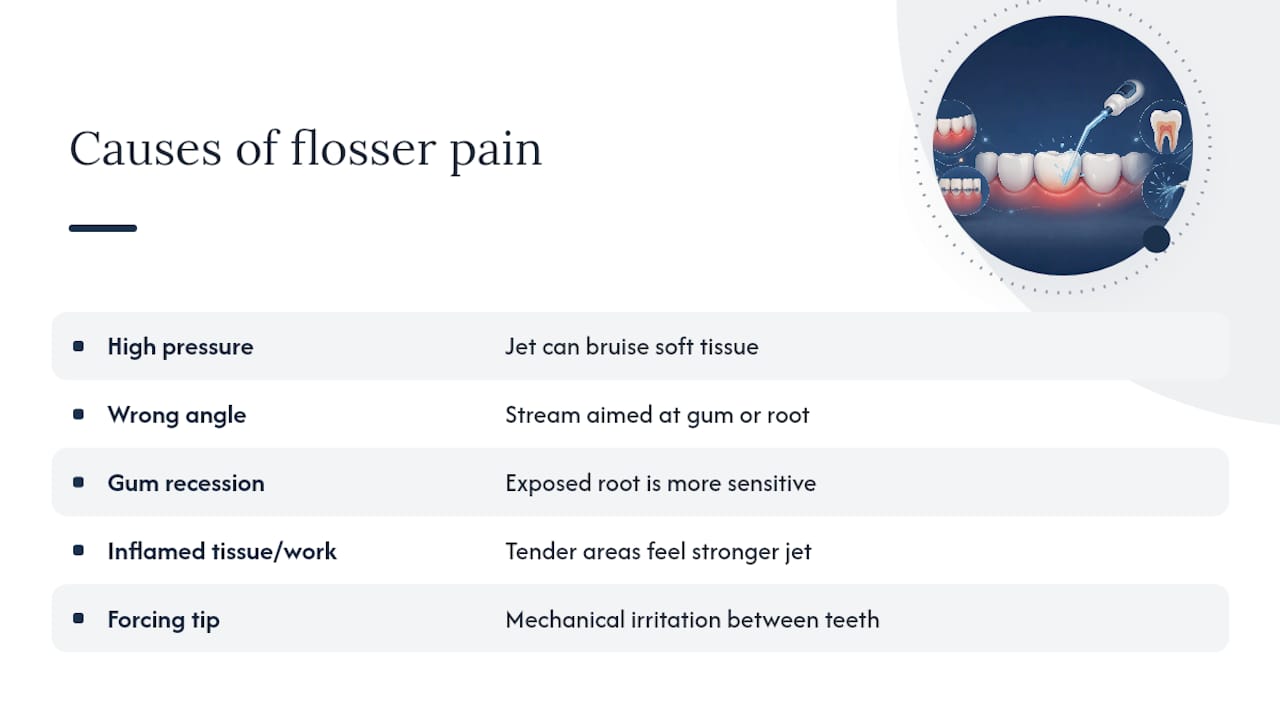
Pressure set too high. Every water flosser has a range of settings, and cranking it to maximum on day one is a bit like sprinting before you’ve stretched. The jet can bruise soft tissue that isn’t ready for that kind of force.
Wrong angle or aim. Pointing the stream straight at the gumline, or worse, directly at an exposed tooth root, sends the pulse exactly where it stings the most.
Gum recession. When gums pull back, the root surface underneath (cementum and dentine) is far more sensitive than the enamel above it. A jet that feels fine on a healthy tooth can feel like an electric shock on an exposed root.
Existing gum disease or recent dental work. Inflamed tissue, a recent filling, or a fresh extraction site is already tender, and irrigation adds sensation to an area that’s already irritated.
Forcing the tip into tight spaces. If you’re wedging the nozzle between teeth that sit close together, you’re creating mechanical irritation the same way string floss does when it’s snapped down too hard.
There’s also a normal adjustment reaction worth knowing about: gums that have been mildly inflamed for a while (often without you noticing) can bleed more the first few times they’re properly stimulated. This isn’t the device causing damage. It’s often the first sign that plaque and inflammation were sitting there before you started.
How to use a water flosser without hurting your teeth or gums
Adjusting pressure and technique may help, but persistent discomfort needs a dental assessment.
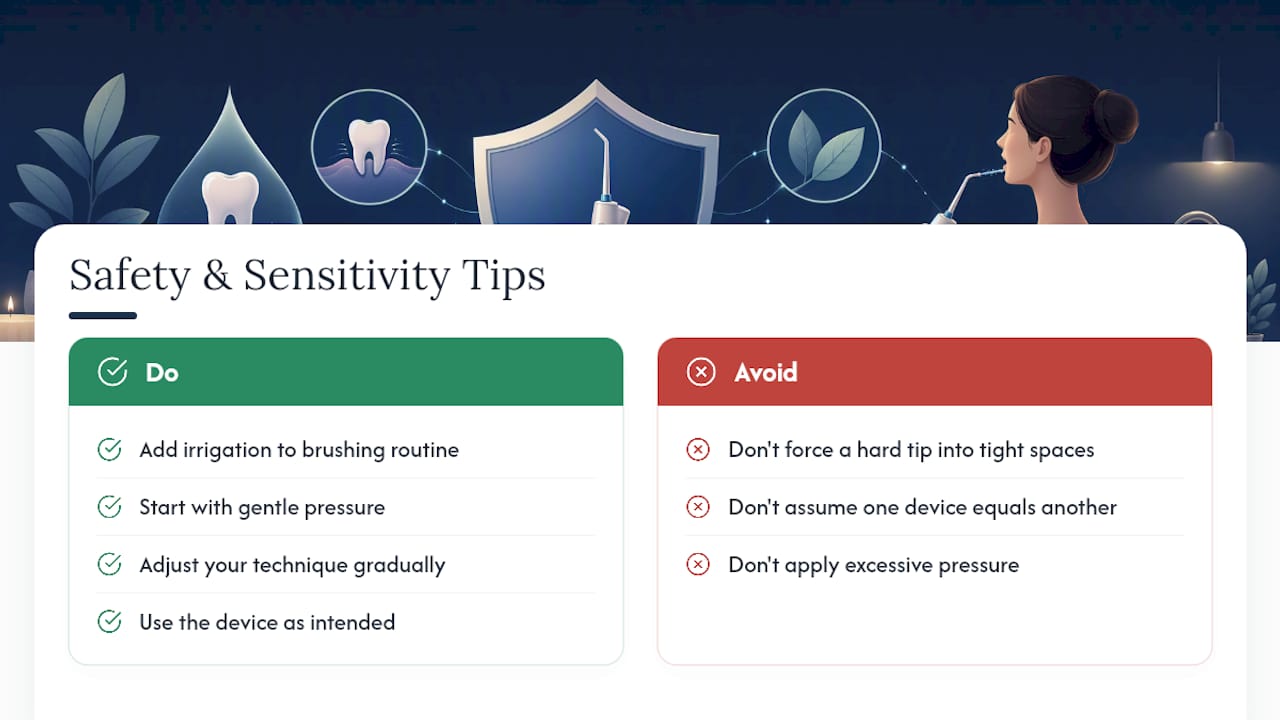
- Start on the lowest pressure setting and increase it only if comfortable. Stop and seek dental advice if use causes pain or bleeding.
- Lean over the sink and close your lips slightly so water can drain out, without you swallowing it.
- Aim the tip at your gumline at roughly a 45-degree angle, not straight into the gum pocket. Let the pulsing water rinse debris away rather than trying to blast it out.
- Work in quadrants (upper right, upper left, lower left, lower right) and spend a few seconds per tooth, pausing briefly between each one.
- Choose the right tip for the job. A soft or subgingival tip is gentler on sensitive spots than a standard jet tip, and it’s worth switching if you’ve got receding gums.
- Use lukewarm water, not cold straight from the tap, particularly if your teeth are already sensitive to temperature.
If you’ve got braces, implants, or a bridge, technique matters even more, and our guide to water flossing with braces covers the specific angles that avoid dislodging brackets or wires.
Pro Tip: Never force the tip between teeth that sit tightly together. If it doesn’t glide in easily, angle it toward the gumline from the outside instead, the pulsation still reaches the space without you having to jam anything in.
When pain or bleeding is normal, and when it’s a red flag
Bleeding or pain deserves attention rather than being assumed to be a normal part of starting.
Possible mild symptoms to discuss with your dentist:
- Light bleeding when you first begin, especially around gums that were already a bit inflamed
- Mild, generalised soreness after a session that fades within a day
- Slightly increased sensitivity to the water temperature itself
Red flags that mean it’s time to see a dentist:
- Sharp, localised pain in one specific tooth
- Sensitivity to cold or biting that doesn’t ease after a week
- Swelling, pus, or a bad taste near one area
- Symptoms that get worse rather than better with gentler technique
Reducing pressure and avoiding direct jets on sensitive areas may help, but ask a dentist about ongoing symptoms. If you’ve recently had scaling, root planing, or an extraction, ask your dentist when it’s safe to resume irrigation. Healing tissue is more reactive, and what counts as “normal” sensitivity changes for a few weeks after treatment.
What the evidence and dental professionals say about safety and sensitivity
The research on oral irrigation is more reassuring than most first-time users expect. A Cochrane review of home-use interdental cleaning devices found that adding irrigation to toothbrushing reduces gingival inflammation and bleeding compared with brushing alone.
A literature review published in Compendium covering decades of trials found no evidence that pulsating oral irrigation damages the tissue attachment holding teeth in place, alongside consistent improvements in gum inflammation and bleeding.
Separate clinical trial data backs this up, showing measurable reductions in plaque and bleeding on probing when irrigation is added to a normal brushing routine. Open-access research supports the same conclusion: irrigation is unlikely to cause lasting tissue damage when used as intended.
The caveat dentists raise consistently is that devices differ, and results from one irrigator don’t automatically apply to another. Reporting on water pick safety notes the jet itself rarely causes permanent harm, but forcing a hard tip into tight spaces can irritate gums regardless of how gentle the water pressure is. The clinical advice is consistent: start gentle, adjust technique, don’t force anything.
Why gum irrigation felt like a shock the first time I tried it
I remember the first time I properly understood how much technique matters with a water flosser, because I did almost everything wrong. Pressure too high, angle too aggressive, no patience for the adjustment period. It stung, my gums bled more than I expected, and I nearly gave up on the whole idea within a week.
What helped me was lowering the pressure and paying attention to technique. Experiences vary, especially around braces or other dental work. Pain or bleeding is worth discussing with a dentist rather than assuming it will resolve on its own.
— Spencer
Which Flossy device suits gums that need a gentler start
If sensitivity is the reason you’re hesitant to keep going, the fix usually isn’t giving up on irrigation, it’s using a device built to let you control the intensity from the very first session.

The Flossy Oral Jet gives you multiple pressure modes, so you can genuinely start on the gentlest setting and build up over days rather than being stuck with one intensity. Its pulsed jets are designed to rinse rather than blast, which matters a lot for anyone dealing with gum recession or braces. The soft tip options suit sensitive sites specifically, and USB-C charging means it’s actually realistic to keep the routine going when you travel, rather than falling back on string floss because the device is sitting in a drawer at home.
If you’re setting up irrigation for two people, the Flossy Couples Bundle covers both of you without buying separately, and households with kids or several family members will get more value from the Flossy Family Bundle, which comes with four jets. However many people in your house need one, the full Flossy range is the place to check current pricing and pick the setup that fits.
Sources
- Cochrane review: Home-use interdental cleaning devices (addition to toothbrushing) — preventing and controlling periodontal disease
- Safety of a water flosser: a literature review — Compendium
- PubMed indexed clinical trial — irrigation improves gingival outcomes
- PMC article on oral irrigation safety
- PopSci: Do water picks work? — April 2026
Findings vary by device design and tip type, so read the full papers if you want the methodology behind each result.
This article is general information, not a substitute for advice from a qualified doctor. Consult a qualified healthcare professional about your own circumstances before acting on anything here.
FAQ
Why do my teeth hurt after using a water flosser?
Usually it’s pressure set too high, an angle aimed directly at the gumline or an exposed root, or gums that were already inflamed before you started. Lowering pressure and adjusting the angle may help, but a dentist should assess persistent or localised pain.
Why don’t dentists recommend water flossers to everyone?
A water flosser can be one option for cleaning around dental work, but the evidence for oral irrigators is limited and results vary by person and device. Ask your dentist what suits your needs.
Why do my teeth hurt sharply right after flossing?
Sharp, localised pain in one tooth (rather than general gum soreness) is a red flag that points to something like a cavity, an exposed root, or existing gum disease rather than normal adjustment. Seek dental advice for sharp or localised pain rather than waiting for a set period.
Can a water flosser damage teeth?
There’s no evidence that pulsating water flossers cause lasting damage to teeth or gum attachment when used correctly. Misusing the hard tip by forcing it into tight spaces can cause irritation, but the water jet itself is considered safe for regular use.
Recommended
Meet the Flossy Oral Jet
Cordless, five nozzles, three pressure modes, and small enough to live in your bag.